How to authenticate a Rolex is the most important skill a secondary market buyer can have — and it’s more necessary in 2026 than it’s ever been. The replica market has reached a level of sophistication that didn’t exist five years ago. Super clones with Swiss movements, correctly weighted cases, and laser-engraved serials are now the standard for high-end fakes, not the exception. A casual eye won’t catch them. A trained, systematic process will — every time. If you want to buy with authentication already handled, browse our verified inventory. If you want to learn how to authenticate a Rolex yourself before any purchase, here’s the full process from step one to definitive confirmation.
Why Knowing How to Authenticate a Rolex Matters More in 2026
In 2015, a convincing fake Rolex cost roughly $500 to produce. The market for fakes was large but the quality ceiling was low — most replicas failed basic visual checks. Today’s super clones cost $1,000–$3,000 to produce. They have Swiss movements. They have 904L steel cases. Some have dial printing that takes magnification to meaningfully distinguish from genuine. The gap between a good fake and a genuine watch has narrowed considerably on the outside.
What hasn’t changed: the inside. The movement finishing, the internal components, the manufacturing tolerances that Rolex applies to the calibers in their watches — these are still beyond what any replica operation produces at scale. Anyone who knows how to authenticate a Rolex properly focuses on these areas, not just the surface details that fakers have gotten better at.
The other thing that hasn’t changed: documentation. Genuine Rolex watches come with specific paperwork at specific production stages. Replicating that paperwork convincingly is difficult and expensive enough that most fake operations don’t attempt it. A serial number, a warranty card, and cross-referencing them together remains one of the most reliable authentication steps available.
How to Authenticate a Rolex: The Complete 8-Point Checklist
This is the same process I run on every watch before it reaches a buyer. Eight points, in the order I do them — starting with the checks that take ten seconds and ending with the ones that need a watchmaker.
1. The Seconds Hand — The First Thing to Check
Watch the seconds hand for 30 seconds. A genuine Rolex mechanical movement beats at 28,800 vibrations per hour — that produces a smooth, continuous sweep of the seconds hand with no visible stepping. Not a tick. Not a step. A sweep. If the seconds hand moves one step per second, the watch has a quartz movement inside. Rolex does not make quartz sport watches. A Submariner, Daytona, or GMT-Master II with a ticking seconds hand is not genuine. That’s it. End of discussion. This one check takes half a minute and eliminates a significant percentage of fakes before you look at anything else.
2. The Caseback — Solid Metal, No Exceptions
Turn the watch over. Every current-production Rolex wears a solid, smooth, plain screw-down caseback. No sapphire crystal exhibition window. No seahorse engraving. No decorative motifs. No visible movement. Just a smooth metal surface with the Rolex name and reference on it. If the watch you’re looking at has a see-through caseback that shows the movement, it is not a current genuine Rolex. This is one of the fastest ways to filter fakes — five seconds, no tools, no expertise required.
3. The Dial — Printing, Applied Elements, and Lume
Under a loupe or good macro photo: text on a genuine Rolex dial is printed at tolerances measured in fractions of a millimetre. Letters are perfectly crisp with zero bleeding, zero variation in line weight, zero pixelation. Each character is mechanically identical in sharpness to every other character on the dial. This level of consistency is extremely difficult to replicate — and fakes, examined closely, typically show subtle inconsistencies in character weight or edge sharpness.
The crown logo at 12 o’clock on most sport references is three-dimensional — raised, domed, with clear depth when viewed at an angle. A flat printed crown is a replica tell on references where it should be applied. Check the angle under a light source; a genuine applied crown reflects differently than a flat printed one.
Lume colour matters: Rolex switched to Chromalight lume around 2008, which glows distinctly blue-white in darkness and maintains brightness for 8+ hours. Genuine post-2008 watches glow blue. Fakes almost universally use green lume because it’s cheaper and more available. A post-2008 Submariner that glows green is a flag worth investigating seriously.
4. The Cyclops Lens — 2.5x Is the Standard
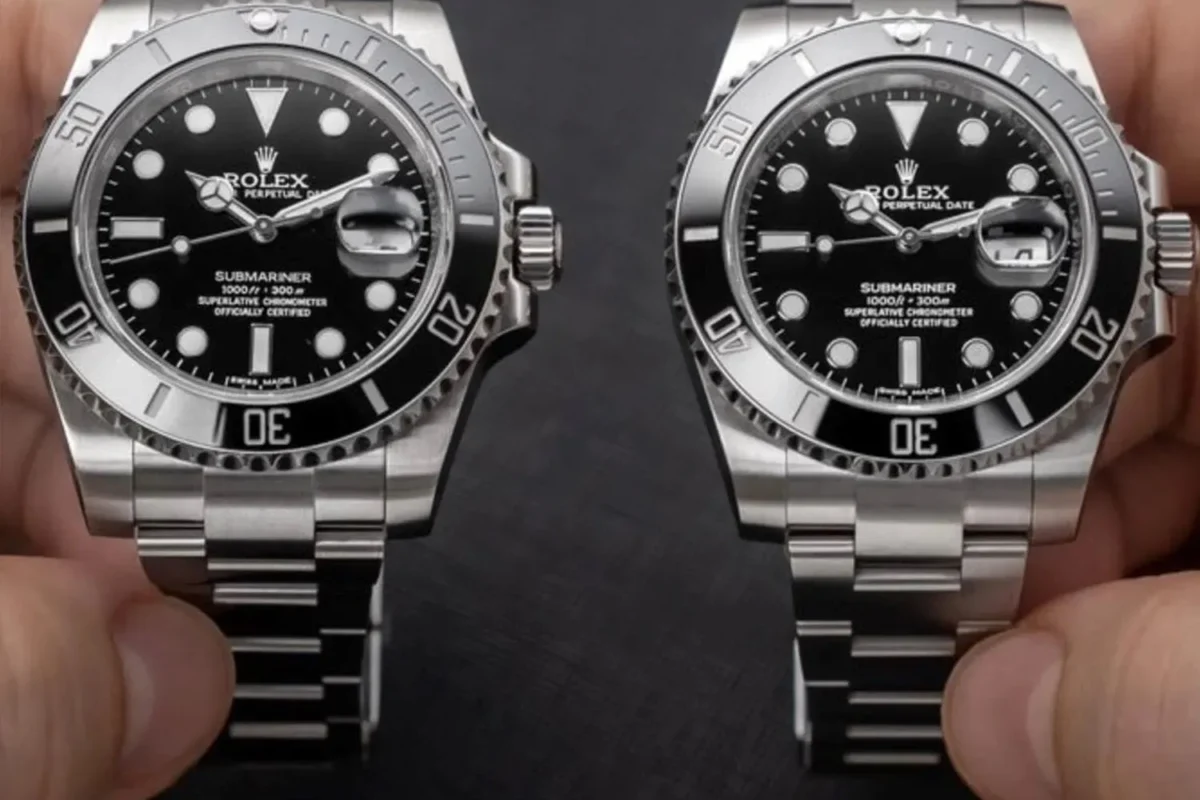
On every Rolex date model, the Cyclops lens above the date window magnifies the date to exactly 2.5 times actual size. Hold the watch at eye level and look at the date through the Cyclops — it should fill the window completely at the correct viewing angle, large and clear. Replica Cyclops lenses almost universally show weaker magnification. A date that looks small, distant, or blurry through the lens means the optical specification isn’t right. Getting magnification exactly correct requires genuine optical engineering — fakers regularly fall short here and it shows immediately once you know what 2.5x looks like.
5. The Case Finishing — Sharp Transitions, Correct Weight
Rolex applies precisely defined brushed and polished surface combinations to every case. The transitions between brushed and polished areas form razor-sharp straight lines — run your thumbnail across the transition and you should feel a clean, definitive edge with no blending. Replica finishing has softer, less defined transitions because the manufacturing precision isn’t there.
Weight is equally diagnostic. Rolex uses 904L Oystersteel — a proprietary alloy that’s harder and denser than the 316L steel used by almost all replica manufacturers. A genuine Submariner has a specific, solid heft. If the watch feels notably light for its size, something is wrong. This isn’t subtle — the weight difference is perceptible without any tools.
Want authentication handled before you buy? Every watch in our inventory has been through all eight of these checks by someone who has inspected hundreds of genuine movements. Browse authenticated inventory or source a specific reference — verification is done before the watch reaches you.
6. The Crown and Bezel — Functional Tests
The winding crown on a genuine Rolex threads down via a Triplock (on dive references) or Twinlock system. Unscrew it — it should rotate smoothly and require a firm, controlled thread action to unscrew and re-thread. Winding the movement should provide clear mechanical resistance that builds as the mainspring loads. A crown that wobbles, threads loosely, or provides no mechanical resistance when winding is a significant concern.
The crown logo engraving should be raised and three-dimensional. On fakes it’s commonly flat or off-centre. Examine it under a loupe — the genuine version has crisp edges and consistent depth on the crown symbol.
On rotating bezel references: the Submariner and Sea-Dweller bezel turns counterclockwise only. The GMT bezel turns both directions. Each click should be mechanically crisp and positive. Replica bezels produce a softer, cheaper-feeling click and the ceramic insert typically sits with slightly more movement than a genuine Rolex bezel allows.
7. Serial and Reference Numbers — Cross-Reference Everything
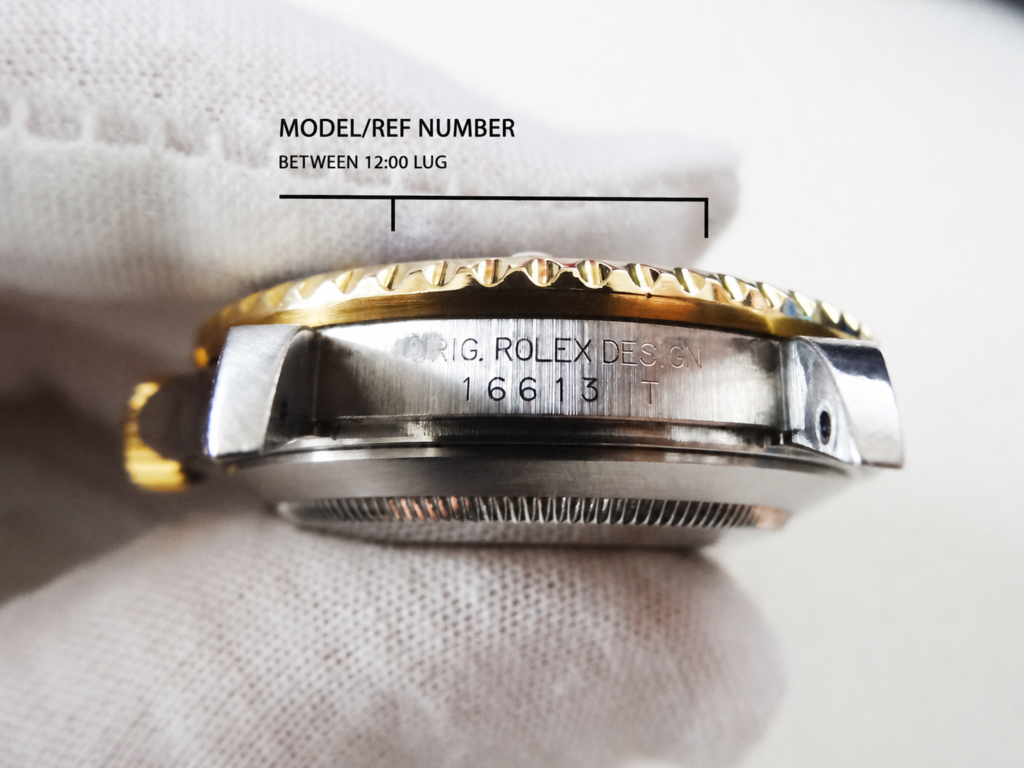
Find the serial: on modern watches (post-2005) it’s on the inner bezel ring or rehaut at 6 o’clock. On pre-2005 watches it’s between the lugs at 6 o’clock with the bracelet removed. The reference number sits at 12 o’clock in the same location. Both should be laser-engraved — perfectly uniform depth, sharp edges, consistent spacing across every character.
Cross-reference the serial against the warranty card. One digit different means the documentation belongs to a different watch. Cross-reference the serial’s approximate production date against the reference’s known launch date — if a serial dates to 2005 on a reference introduced in 2020, components have been swapped or the serial is fabricated. Then run it through The Watch Register to check for reported theft. That takes 60 seconds and has caught real stolen pieces for real buyers more times than I can count.
8. The Movement — The Definitive Test
This requires a watchmaker, but what’s inside is conclusive. A genuine Rolex Caliber 3235 (Submariner, Datejust, GMT post-2018) or 4131 (Daytona) has Geneva wave finishing, Côtes de Genève decoration on bridges and plates, bevelled and polished edges on every component, and an engrave rotor with specific finishing characteristics. Replicating this at a level that passes expert inspection is effectively impossible within any fake production budget. The movement is the hardest part to fake and the most definitive authentication evidence available. If you can’t inspect it personally, buy from someone who has.
How to Authenticate a Rolex When Buying Online
More Rolex purchases happen remotely now than ever before — through platforms, dealers, and private sellers across different countries. Knowing how to authenticate a Rolex without the watch in your hands requires a different approach.
Request high-resolution photographs of every authentication point. Caseback (showing solid steel), dial (under macro, showing printing quality), Cyclops (showing magnification), serial (close-up of engraving at the rehaut or between the lugs), and movement (if the seller is willing to open it). Any reputable seller will provide these without hesitation.
Ask for a video of the seconds hand. A 30-second video of the running watch shows whether the sweep is continuous or stepping. This is the single most diagnostic test for remote authentication and takes no expertise to assess — the seconds hand either sweeps or ticks.
Request the serial number before any payment. Run it through The Watch Register yourself. Match it against the warranty card number in the photographs. If the seller resists sharing the serial, that’s your answer.
Buy through platforms with buyer protection or escrow. If the watch doesn’t match its representation after in-person inspection, you should have a clear return mechanism. Private sales without this protection carry risk that platform sales don’t.
Use a professional third-party authentication service for high-value pieces. For a Daytona at $30,000+, services like Entrupy or a local certified watchmaker’s in-person assessment before releasing payment is money very well spent.
How to Authenticate a Rolex by Reference: What’s Different Per Model
The eight-point process above applies universally, but specific references have their own additional authentication considerations worth knowing.
Submariner (126610LN, 126610LV)
Bezel click direction (counterclockwise only) and the ceramic insert seating are the additional tests here. On a genuine current Sub, the black or green ceramic bezel insert sits flush with zero movement in any direction. The green Kermit bezel is more frequently faked than the black — check the ceramic colour consistency and the colour uniformity under light.
Daytona (116500LN, 126500LN)
The most-faked reference in the catalogue. Sub-dial printing is the most reliable additional test — on a genuine Daytona, the text around each sub-dial (tachymeter scale, register markings) is perfectly consistent. The pushers at 2 and 4 o’clock should operate with a clean mechanical action that resets the chronograph correctly. Any stickiness or imprecision in the pusher action is a flag. The caseback engraving on a genuine Daytona has specific text in a specific font — compare against documented genuine examples.
GMT-Master II (126710BLNR, 126710BLRO)
The ceramic bezel on both variants should have perfectly consistent colour throughout — no lighter or darker patches, no variation in the colour boundary between the two-colour sections. The GMT hand (the additional hour hand with a triangular tip) should move in one-hour increments when the crown is in the second position. Test this: pull the crown to position 2 and rotate — the GMT hand should step one hour per click. If it doesn’t move independently of the main hour hand, something is wrong.
The Paper Trail: Documentation as an Authentication Tool
Knowing how to authenticate a Rolex isn’t just about the physical watch — documentation is half the picture, and it’s the half that buyers most often overlook.
Modern Rolex watches (purchased 2021 onward) come with a green Rolex Guarantee card — credit-card format, with an embedded chip and QR code that links to a Rolex verification page. The serial number on this card must match the serial on the watch exactly. The QR code should resolve to a genuine Rolex verification page when scanned. If it doesn’t scan, redirects to an unusual URL, or the serial shown differs from the physical watch, that’s a documentation problem that can’t be explained away.
Pre-2021 watches came with a printed green booklet warranty card, often with a dealer stamp and handwritten purchase date. For older references, collector community knowledge of what the correct warranty card format looks like for a given year is extensive — if you’re buying a 2014 Submariner, examples of what the genuine 2014 warranty card looks like are well-documented online.
Original box and inner cushion are also worth checking. Replica operations rarely produce convincing boxes — the printing quality, the box material weight, and the leather finish on the inner cushion are all measurably below the genuine article when you’ve handled both. A mismatched box (the box says Submariner, the watch is a Daytona) is an immediate flag that components have been assembled from different sources.
Red Flags That Should Stop Any Purchase Immediately
When you’re learning how to authenticate a Rolex, there are certain signals that are so clear they should end the conversation before any further examination:
- Price meaningfully below secondary market value with no credible explanation. A Submariner at $8,000 in 2026 is not a bargain — it’s a flag. Market pricing is well-documented and consistent.
- Ticking seconds hand. Immediate disqualifier on any sport reference.
- Exhibition caseback. No current genuine Rolex sport watch has one.
- Seller won’t share the serial before payment. Legitimate sellers have nothing to hide and will share it without being asked twice.
- Serial doesn’t match the warranty card. Non-negotiable. One digit different is the same as completely different.
- Weak Cyclops magnification. If the date looks small through the lens, the optical specification is wrong.
- Watch feels light for its size. 904L Oystersteel has a specific heft. Lightweight means 316L or cheaper alloy.
- Seller won’t allow pre-purchase inspection or third-party assessment. Any legitimate seller welcomes scrutiny.
What “Authenticated” Actually Means — and What It Doesn’t
The word is used loosely enough in the secondary market that it’s worth being direct about what it means when it means something. Some sellers call a watch “authenticated” because they looked at it, decided it seemed real, and listed it. That’s not authentication. That’s an opinion from someone with unknown expertise and nothing at stake if they’re wrong.
Real authentication is a documented, systematic process: movement inspection by someone who has opened and examined hundreds of genuine Rolex calibers, dial inspection under magnification, serial and reference cross-referencing against known production data, warranty documentation review, case and bracelet assessment, and functional testing of every mechanism. All eight points. Documented results. With something at stake if any step is wrong.
At Crown Watch Group, that process is how we buy — not how we sell. Every watch we reject goes back into the market through other channels. Every watch we accept has passed an assessment that I’m personally comfortable putting my name behind. That standard exists because it has to — it’s the only thing that makes the words “authenticated” and “guaranteed” mean anything real.
Frequently Asked Questions About How to Authenticate a Rolex
How do I authenticate a Rolex at home?
To authenticate a Rolex at home without specialist tools: check the seconds hand sweep (smooth vs ticking), confirm the caseback is solid with no exhibition window, test the Cyclops magnification (should fill the date window at 2.5x), check the dial printing under a strong loupe or macro photograph, and verify the serial matches the warranty card exactly. These steps catch the majority of fakes without opening the case.
How can I tell if a Rolex is real without opening it?
The seconds hand, caseback, Cyclops magnification, and weight are the four most diagnostic non-invasive tests. A continuous sweep, solid caseback, strong 2.5x magnification, and correct heft together rule out most fakes. Movement inspection remains the definitive test — but knowing how to authenticate a Rolex well at the surface level catches most counterfeits before it comes to that.
What is the easiest way to spot a fake Rolex?
The seconds hand is the fastest test — 30 seconds, no tools, no expertise required. A ticking seconds hand means quartz movement; Rolex sport watches are mechanical only. The second fastest is flipping the watch over: exhibition caseback means fake, every time on current sport references.
Can a fake Rolex fool an expert?
A modern super clone can fool someone who relies on surface inspection only. It does not fool someone who opens the caseback and examines the movement. The movement is the most complex component and the hardest to replicate at any reasonable cost — and that’s exactly why movement inspection is the definitive step in how to authenticate a Rolex properly.
Is it safe to buy a Rolex on the secondary market?
Yes — when you buy from a source that has completed a documented, multi-point authentication process on every watch before selling it. The risk is buying from someone who hasn’t done the work or doesn’t have the expertise to do it correctly. A dealer who authenticates systematically and stands behind every piece they sell eliminates that risk entirely.
How much does Rolex authentication cost?
Professional third-party authentication by a certified watchmaker typically costs $150–$350 depending on the level of inspection and the examiner. For a $30,000 Daytona, that’s a rounding error. For watches bought through dealers who authenticate before listing, the cost is built into the service — you’re not paying separately for a check that’s already been done.
The Bottom Line on How to Authenticate a Rolex
Knowing how to authenticate a Rolex gives you real protection in the secondary market — but the process only works when you actually run through it, not when you plan to. Seconds hand sweep, solid caseback, Cyclops magnification, dial quality, case weight, crown function, serial cross-check, and movement inspection. Eight points. In that order. The ones at the start take seconds. The one at the end is definitive.
For any purchase above $15,000, combining your own inspection with professional third-party authentication before releasing payment is the most sensible approach regardless of how much you trust the seller.
Every watch in our inventory has been through all eight steps before listing. We’ve turned down pieces that looked right on the outside and failed at the movement. That process is what we offer — not just the watch, but confidence in exactly what you’re buying. Browse available inventory or tell us what you’re looking for and we’ll source it with the same verification applied from the start.
Ready to Source Your Rolex?
Let Us Find the Watch You've Been Looking For
No waitlists. No guesswork. Authenticated Rolex watches sourced directly for you.
Request a Watch